Friday, March 15, 2013
Explaining the Debt Limit: How an Absurd Video Makes the Debit Limit Debate Understandable
This video is a must see and pretty much explains itself:

Tuesday, March 12, 2013
California Fire Prevention Fees Are Not Tax Deductible Says IRS
California has begun mailing bills to rural property owners for fire prevention. If you own habitable property the CalFire's jurisdiction, you will eventually receive two bills this year--one for the State's 2011-2012 fiscal year, and one for its 2012-2013 fiscal year.
Each bill will be $150 per habitable structure on your property. So if you have one house on your property and no other habitable structures, you will receive two bills this year totaling $300.
The Howard Jarvis Taxpayer Association warns:
Unfortunately, it appears the IRS has taken the position in a recent Memorandum that such payments are not deductible property taxes.
Office of Chief Counsel, IRS Memorandum 2013-10-029 (Jan. 14, 2013) (released Mar. 8, 2013):
Each bill will be $150 per habitable structure on your property. So if you have one house on your property and no other habitable structures, you will receive two bills this year totaling $300.
The Howard Jarvis Taxpayer Association warns:
PAY CLOSE ATTENTION TO THE DUE DATE. You may have fewer than 30 days to pay. If you are late, there is a 20% penalty, plus interest. Every 30 days after that, another 20% penalty is added, plus interest. The fee is a lien on your property, and failure to pay can result in foreclosure.
Unfortunately, it appears the IRS has taken the position in a recent Memorandum that such payments are not deductible property taxes.
Office of Chief Counsel, IRS Memorandum 2013-10-029 (Jan. 14, 2013) (released Mar. 8, 2013):
Issue: May California residents deduct the Fire Prevention Fee they may pay on their federal income tax returns as a real property tax deduction under section 164 of the Internal Revenue Code and § 1.164-4 of the Income Tax Regulations?Conclusion: California residents may not deduct the Fire Prevention Fee as a real property tax deduction because (i) the fee is not a tax under California or federal law (ii) the fee is not levied at a like rate, (iii) the fee is not imposed throughout the taxing authority's jurisdiction, and (iv) the fee is assessed only against specific property to provide a local benefit
Thursday, March 7, 2013
Camp Taylor--Helping Kids With Heart Disease
Michael Goldring from our office and his daughter, Rachael, were featured on KSEE 24 recently to talk about heat disease on how children who suffer from it can benefit from Camp Taylor.
Click here for their video appearance.
Click here for their video appearance.
Friday, March 1, 2013
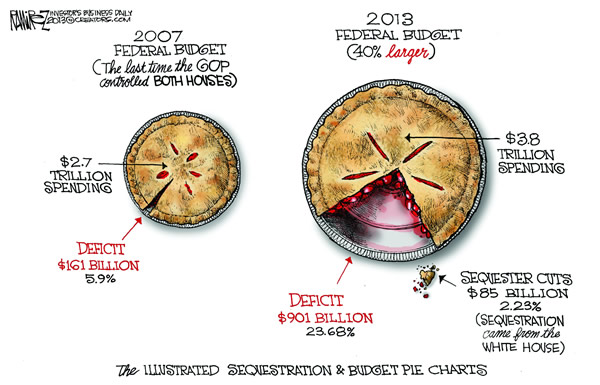
A Sequestration Visual Aid
Cartoonist Michael Ramirez offers a helpful visual of the level of planned cuts under Sequestration.


Thursday, February 28, 2013
The "Jock Tax" Payback: How Pro Athletes Are Cashing in on CA Worker's Comp
Many readers may be familiar with the fact that most states have their own version of the "Jock Tax". Essentially, if a pro-athlete and resident of a neighboring state plays a game your state, your state will be owed an amount of income tax from that athlete since the athlete is essentially conducting business in your state. Although the average citizen would see this as a blatant maneuver to fill state coffers from wealthy pros, almost all states have enacted their own version of a Jock Tax.
Now it appears the Jocks have a way to fight back--filing worker's comp claims.
Consider this: A professional football player and resident of Colorado, in the course of his 88 game career ends up playing just 9 games in California. After retiring he gets awarded a $199,000 injury settlement from the California workers compensation court for his football injuries. The player. Terrel Davis, former Super Bowl MVP and Denver Broncos running back.
A recent article in the LA Times gives the details:
Now it appears the Jocks have a way to fight back--filing worker's comp claims.
Consider this: A professional football player and resident of Colorado, in the course of his 88 game career ends up playing just 9 games in California. After retiring he gets awarded a $199,000 injury settlement from the California workers compensation court for his football injuries. The player. Terrel Davis, former Super Bowl MVP and Denver Broncos running back.
A recent article in the LA Times gives the details:
Over the last three decades, California's workers' compensation system has awarded millions of dollars in benefits for job-related injuries to thousands of professional athletes. The vast majority worked for out-of-state teams; some played as little as one game in the Golden State.
All states allow professional athletes to claim workers' compensation payments for specific job-related injuries — such as a busted knee, torn tendon or ruptured spinal disc — that happened within their borders. But California is one of the few that provides additional payments for the cumulative effect of injuries that occur over years of playing.
A growing roster of athletes are using this provision in California law to claim benefits. Since the early 1980s, an estimated $747 million has been paid out to about 4,500 players, according to an August study commissioned by major professional sports leagues.
Monday, February 25, 2013
Over-Hyped Sequestration Amounts to One Week's Worth of Spending Cuts
Given the amount of doom and gloom that is reported surrounding the impending sequestration cuts, one may be surprised to learn that the cuts will result in a decrease in projected spending by only 2.3%. Hardly an unmanageable amount.
Put another way, it would be equivalent to having Federal spending take a week long holiday.
Despite these figures, sequestration has been presented by politicians and the media as the next "cliff" (didn't we just avert one a few weeks ago?). For instance, just this weekend, the White House released a menacing 7 page memorandum listing all the programs, services and agencies that would be affected. Obviously, the list is meant to incite emotion and evoke fear. After all, the document tells us that their will be cuts to food safety inspectors, airport security, national parks, education, amongst many, many more.
As I read through the list, I couldn't help but remember a similar menacing list produced by Governor Jerry Brown in his campaign to pass Proposition 30. Californians were told that if we didn't vote for increased taxes, key government services would be shut down. In fact, the Governor even released the names of dozens of state parks that were to be "closed" in the event that Proposition 30 did not pass. These scare tactics apparently worked and Proposition 30 ultimately passed. Of course, its passage seemed to only wet the appetite of those who have always sought increased taxes--within weeks the democratic super majority was alluding to other ways to increase revenues.
The pattern is clear. If you want create the perception that a small decrease in spending will have terrible consequences, you have to place on the chopping block those services that are most near and dear to taxpayers--public safety. I am not saying that public safety will actually be cut, but the government will publicize "planned" cuts to public safety more than anything else. I suspect though that sequestration will not result in a drastic drop in public safety as the politicians would lead us to believe.
Put another way, it would be equivalent to having Federal spending take a week long holiday.
Despite these figures, sequestration has been presented by politicians and the media as the next "cliff" (didn't we just avert one a few weeks ago?). For instance, just this weekend, the White House released a menacing 7 page memorandum listing all the programs, services and agencies that would be affected. Obviously, the list is meant to incite emotion and evoke fear. After all, the document tells us that their will be cuts to food safety inspectors, airport security, national parks, education, amongst many, many more.
As I read through the list, I couldn't help but remember a similar menacing list produced by Governor Jerry Brown in his campaign to pass Proposition 30. Californians were told that if we didn't vote for increased taxes, key government services would be shut down. In fact, the Governor even released the names of dozens of state parks that were to be "closed" in the event that Proposition 30 did not pass. These scare tactics apparently worked and Proposition 30 ultimately passed. Of course, its passage seemed to only wet the appetite of those who have always sought increased taxes--within weeks the democratic super majority was alluding to other ways to increase revenues.
The pattern is clear. If you want create the perception that a small decrease in spending will have terrible consequences, you have to place on the chopping block those services that are most near and dear to taxpayers--public safety. I am not saying that public safety will actually be cut, but the government will publicize "planned" cuts to public safety more than anything else. I suspect though that sequestration will not result in a drastic drop in public safety as the politicians would lead us to believe.
Thursday, February 21, 2013
"Gentle Soul" Shoe Shiner Donates $200K to Charity--But Beware of the Tax Man
From WTAE Pittsburgh:
For 32 years, [Albert] Lexie has been examining his schedule each morning, like a doctor on the clock. But the longtime shoe shiner’s gift isn’t healing, it’s giving back. A shoe shine costs $5, but Lexie said customers have been generous with their tips since he started working at the hospital in 1981.No doubt about it. Mr. Lexie has quietly and consistly done something noble and great by turning over his tips to a worthwhile charity. However, this raises some very interesting tax implications. In particular, it is well-settled that amounts received as tips are "income" for income tax purposes and should be reported on a person's tax return. Now you would hope that the fact Mr. Lexie simply donated these funds to charity would absolve him of any tax liability for those tips, but that isn't necessarily the case. The reason why is that one's charitable donations are not always 100% deductible.
“Most of them give $6, some of them give $7,” Lexie told Channel 4 Action News anchor Wendy Bell.
And Lexie gives every cent of his tips back to the children.
“I think he does it because he loves the kids,” said Dr. Joseph Carcillo. “He's donated over a third of his lifetime salary to the Children’s Hospital Free Care Fund.”
The money goes to parents of sick children who can’t afford to pay medical costs.
“He's a philanthropist, is what he is,” said Carcillo. “He's an entrepreneur.”
Lexie has donated $200,000 to the cause, bringing in several hundred dollars a week.
In this case, it is likely that Mr. Lexie could only deduct these donated tips up to 50% of his adjusted gross income (and remember his AGI would include this tip income). If, for instance, his donated tips ever exceeded 50% of his AGI, then he would not be able to deduct the full amount of donated tips that year. While these excess donations can be rolled over for up to 5 years, it doesn't do Mr. Lexie much good if every year he is maxing out this deduction limitation. On a related not, it is unclear what documentation the hospital has provided Mr. Lexie each year that would enable him to substantiate these deductions, if ever questioned.
In all, Mr. Lexie has done a noble thing...let's just hope the IRS doesn't take notice.
Subscribe to:
Posts (Atom)